

Carpal tunnel syndrome is one of the most common conditions treated by hand surgeons. If you’re reading this, you may already know the frustrating symptoms: numbness, tingling, grip weakness, nighttime pain, or hand and forearm cramping. When splints and activity/positional changes no longer provide relief, surgery may be the next step.

Dr. Tony Trenga is a fellowship-trained hand surgeon at Hand to Shoulder Specialists of Wisconsin and the Orthopaedic Hospital of Wisconsin here to answer questions related to carpal tunnel surgery and its options.
One of the most common questions is:
What is the difference between open carpal tunnel release and endoscopic carpal tunnel release?
Let’s examine this in detail.
What is carpal tunnel release surgery?
Carpal tunnel syndrome happens when the median nerve becomes compressed at the wrist. Surgery treats this by cutting the transverse carpal ligament, which forms the “roof” of the tunnel. Once released, pressure on the nerve decreases, allowing it to recover.
There are two main ways to perform this procedure:
- Open carpal tunnel release
- Endoscopic carpal tunnel release
Both procedures aim to fully release the ligament and relieve pressure on the nerve. The difference lies in how the ligament is reached and visualized.
What is open carpal tunnel release?
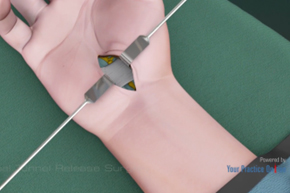
In traditional open surgery, a small incision is made in the palm. Through this incision, the ligament is directly visualized and divided under direct sight.
This technique has been performed for decades and has excellent long-term outcomes. It allows wide visualization of the anatomy and is very reliable.
What is endoscopic carpal tunnel release?
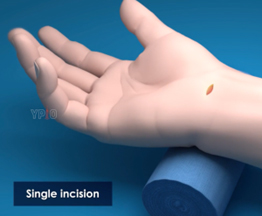
Endoscopic carpal tunnel release is a minimally invasive technique with many years of evidence and research. Instead of making an incision in the palm, a small incision is typically made at the wrist. A thin camera (called an endoscope) is inserted beneath the ligament. Using this camera for guidance, the ligament is divided from the inside-out.
In traditional open carpal tunnel release. the superficial skin, fat and muscle must be dissected to reach the transverse carpal ligament. Because the palm skin and underlying tissue are not divided in endoscopic carpal tunnel, there is less disruption of the sensitive tissues in the center of the hand. This leads to less pain and earlier return to work and activities.
Are the long-term results the same?
Yes. High-quality studies show that both open and endoscopic techniques are equally effective at relieving symptoms in the long-term. Patients in both groups experience significant improvement in numbness, pain, and hand function.
In other words, both procedures work.
So why choose endoscopic release?
The advantages of endoscopic carpal tunnel release are mostly seen in the early recovery period.
- Faster return to work
Multiple studies show that patients who undergo endoscopic release return to work about one week earlier on average compared to open surgery. - Less early postoperative pain
Because the incision avoids the central palm, patients often experience less scar tenderness and less discomfort in the first few weeks after surgery. This is known as “pillar pain.” - Earlier recovery of grip strength
Endoscopic release has been associated with faster early recovery of grip and pinch strength, particularly in the first several weeks after surgery.
These early benefits can be especially important for patients who rely heavily on their hands for work, caregiving, or daily activities.
Are there downsides to endoscopic surgery?
No surgery is without risk. Studies show that endoscopic release may have a slightly higher rate of temporary nerve irritation (called neurapraxia), although permanent nerve injury is rare with both techniques.
Additionally, endoscopic surgery requires specific training and experience by a fellowship-trained hand surgeon. When performed by a surgeon who is comfortable with the technique, it is considered safe and effective.
Which procedure do I recommend?

The best procedure depends on several factors:
- Your anatomy
- Prior wrist surgery
- Severity of nerve compression
- Work demands
- Personal preference
For many patients, endoscopic carpal tunnel release offers the same long-term relief with a quicker early recovery. For others, an open approach may be more appropriate. Generally, if the carpal tunnel has previously been released through open or endoscopic methods and a revision surgery is needed, an open technique is needed.
The most important goal is complete release of the ligament and safe decompression of the nerve.
What can you expect during and after surgery?
Endoscopic carpal tunnel release is typically performed as an outpatient procedure (go home the same day). It can be done under local anesthetic only (Wide-Awake Local Anesthesia with No Tourniquet – WALANT) or under general anesthesia, depending on patient preferences, comfort level, and other medical conditions. I perform most of my surgeries at the Orthopaedic Hospital of Wisconsin (OHOW); though depending on your health insurance and location, the procedure can be performed at several facilities throughout Southeastern Wisconsin.
Immediately after surgery patients are allowed to use the operative hand for light activity such as using a fork and knife, computer, cell phone, driving, or holding a cup of coffee. A soft dressing is applied which can be removed 3 days after surgery; at that point patients may remove the dressing and get the hand wet and wash with soap and water in the sink and in the shower. A single stitch remains in place for 10-14 days and can be covered with a simple band-aid until it is removed in the office. Most patients require only acetaminophen and ibuprofen for post-operative pain control.
Depending on post-operative discomfort, wound healing, and occupation, patients may increase their activity rapidly after the first visit.
Improvement in nighttime symptoms and carpal tunnel syndrome-related pain and cramping is often rapid. Numbness may take longer to improve, especially in more severe cases.
Final thoughts
If you are struggling with carpal tunnel syndrome and non-operative treatment is no longer helping, surgery can be life-changing. Both open and endoscopic techniques are effective; The difference greatly lies in how quickly you recover in the first few weeks and allowing you to return to work and activities that you enjoy.
For assistance with any problem of the hand, wrist, elbow, or shoulder, call (414) 453-7418 or visit HSSWI.com to schedule an appointment today.
About Dr. Trenga:
Anthony P. Trenga, MD is a fellowship-trained hand surgeon specializing in all aspects of the hand, shoulder, and elbow. Originally from the east coast, Dr. Trenga, his wife, and two children have made Wisconsin home for more than half a decade. Dr. Trenga sees patients throughout the greater Milwaukee area.
About Hand to Shoulder Specialists of Wisconsin:
HSSWI, formerly Hand Surgery Ltd, is dedicated to treating all aspects of the upper extremity in Southeastern Wisconsin. All surgeons at HSSWI are fellowship-trained in hand and upper extremity surgery to provide comprehensive subspecialist care unique to the region.
References:
- Carpal tunnel syndrome: rapid evidence review. American Family Physician, 2024
- Open compared with 2-portal endoscopic carpal tunnel release: a 5-year follow-up of a randomized controlled trial. The Journal of Hand Surgery, 2009
- Endoscopic release for carpal tunnel syndrome. The Cochrane Database of Systematic Reviews, 2014
- Open versus endoscopic carpal tunnel release: a meta-analysis of randomized controlled trials. Clinical Orthopaedics and Related Research, 2015
- Outcomes of endoscopic surgery compared with open surgery for carpal tunnel syndrome among employed patients: randomised controlled trial. BMJ, 2006


